
From the Installation and Service Team at ProTech Security. Current as of October 28, 2026.
Earlier this month, we wrote about fire alarms that still call for help over copper phone lines. The question we hear next is a practical one: the phone company is moving the building to fiber or internet phone service, so can the alarm lines just move with it?
Not by themselves. Here’s what changes, which lines to check, and what to do before the switch. We work in Ohio and Florida, but the first steps are the same anywhere.
What risk do I have?
A fire alarm that uses a traditional copper phone line sends its signals to the monitoring center through a telephone communicator. Traditional copper telephone service generally receives power from the phone company’s network. A move to fiber can change both the way those signals travel and the equipment that needs backup power in your building.
VoIP telephone service and an IP fire alarm communicator are not the same thing. VoIP carries telephone calls over a data connection. Plugging an existing alarm’s phone cord into a VoIP adapter does not turn it into an IP fire alarm communicator or establish that its signals will get through reliably.
An IP fire alarm communicator is equipment designed to send alarm signals over a network connection. It must be appropriate for fire alarm use, compatible with the panel and monitoring service, and installed and tested for that system. A cellular fire alarm communicator sends signals over a cellular network. Some systems use both paths.
Putting a fire alarm on fiber starts with evaluating the equipment you already have. Some systems can use IP or cellular through additional equipment without replacing the panel. Others need different changes. Programming alone is not always sufficient, and cellular is not the only option. The right answer depends on the panel, communicator, available service, backup power, and applicable requirements.
The fire alarm usually isn’t the only line with a safety job. Elevator phones let someone trapped in a car call for help. Two-way call boxes at elevator landings and areas of refuge, the protected spots where people who can’t use the stairs wait for help, do the same. Many of them call out over phone lines too, and each has its own requirements. One fix doesn’t cover all three.
How do I know whether it affects me?
Start with the phone company. Watch for any letter, email, text, or call about upgrading your phone service, moving lines to fiber, or installing new equipment, and call your fire alarm company before you schedule anything.
Don’t wait for a notice to find out which lines your building depends on. Ask the phone company whether your alarm lines are included in the change and share that information with your fire alarm company.
Then take stock of the lines in your building that have a safety job:
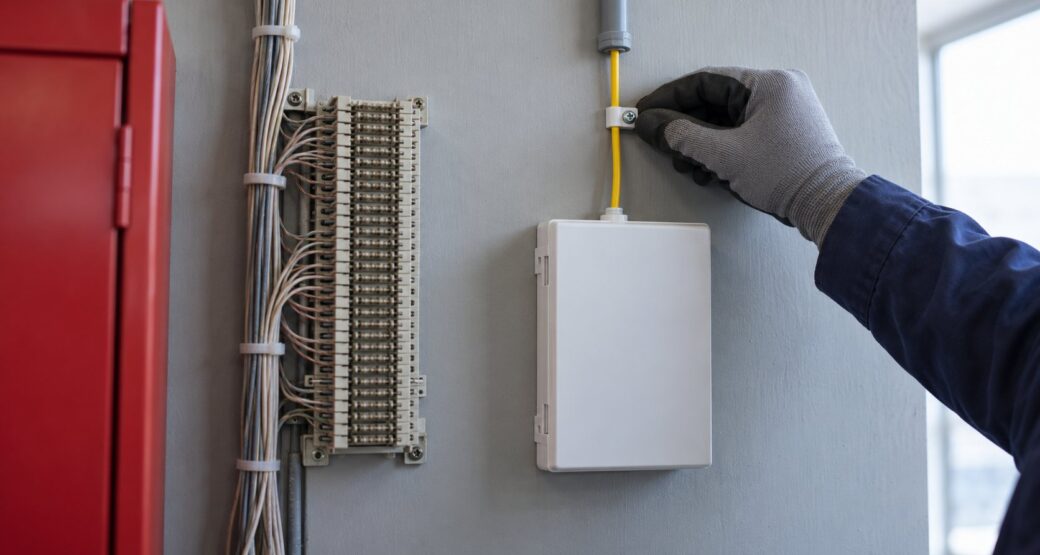
- The fire alarm. Look for a phone cord from the panel to a wall jack. Many fire alarm communicators use two phone lines. Use the comparison below as a starting point, then have your fire alarm company confirm the connection.
- The elevators. Elevator emergency phones often call out over phone lines.
- Elevator landings and areas of refuge. Look for two-way call boxes, usually on floors above or below the main exit.
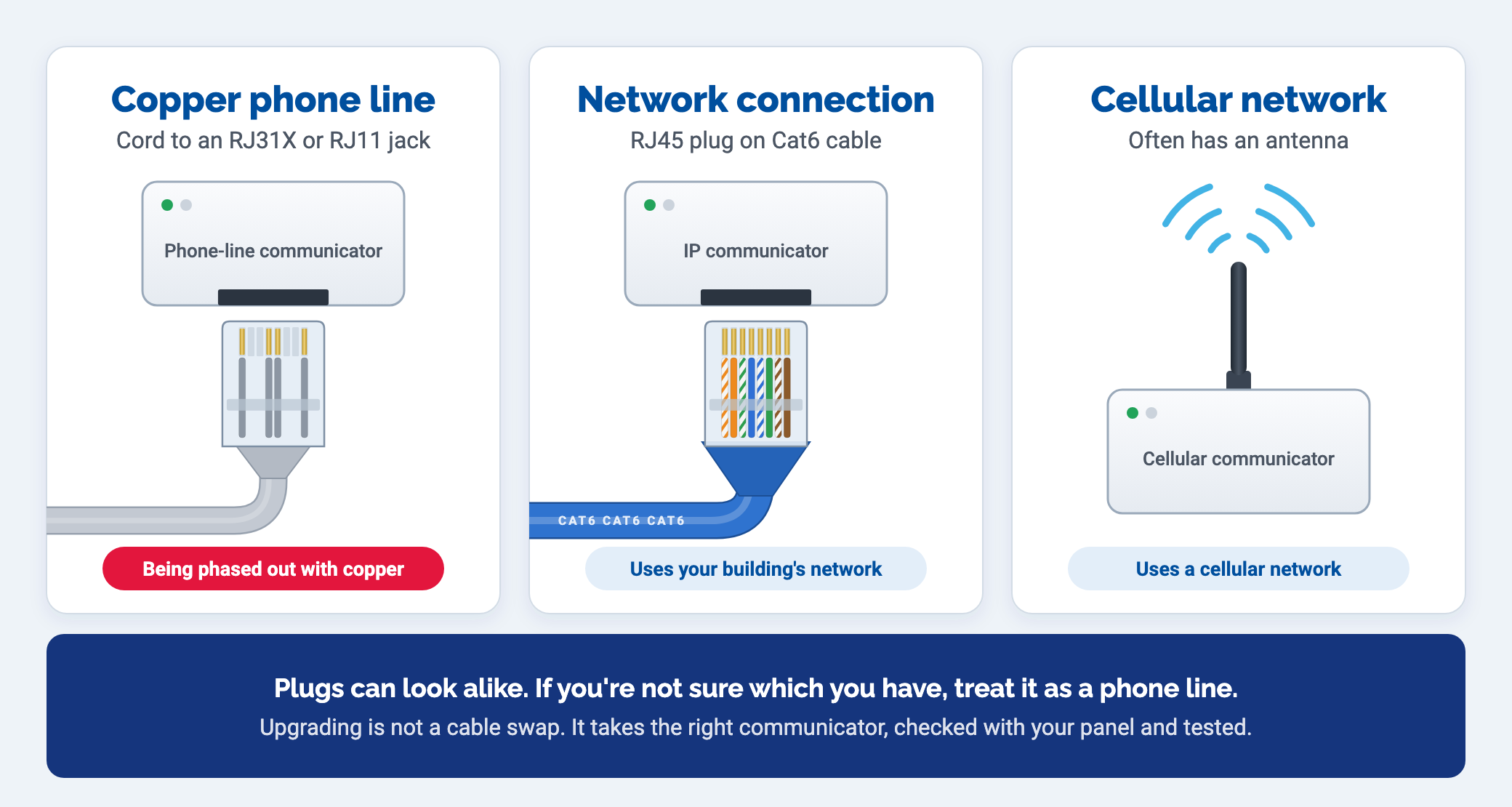
These are visual clues, not a compatibility test. Some telephone connections use plugs that look like network plugs. A jack’s shape does not confirm how the alarm communicates. Do not unplug or change the connections; have your fire alarm company identify them.
If you aren’t sure what you have, request a fire alarm communication evaluation. Your first phone consultation is free.
What should I do about it?
- Call before the install. Ask the phone company when the switch happens and which lines it covers, then talk to your fire alarm company before the work is scheduled.
- Evaluate the existing equipment. Have the panel, communicator, current monitoring connection, and backup power checked before deciding what to change.
- Choose the appropriate communication method. Depending on the system, that may mean adding compatible IP or cellular equipment, using both paths, or making other equipment and programming changes. Confirm compatibility with the monitoring center and the requirements for your building.
- Plan every other safety line on its own. Bring your elevator company in on the elevator phones, and make sure the call boxes have a plan too. If any of them will run over the new service, ask how long it stays up in a power outage.
- Coordinate and test the change. Have your fire alarm company coordinate the transition with the monitoring provider and confirm that the required signals reach the monitoring center. Complete that verification before the old connection is disconnected.
Your fire alarm company should also confirm the applicable state and local requirements with the authority having jurisdiction, usually the local fire or building official. In Ohio, the fire code addresses permission for changes to an accepted system, including its alarm communication method. In Florida, the monitoring rule sets conditions for using a managed voice network to carry alarm signals. In either state, a phone company’s fiber installation does not by itself establish that the fire alarm’s communication setup meets the requirements.
Why should I call ProTech?
Our teams in North Canton, Ohio, and Orlando, Florida, install, inspect, and service commercial fire alarm systems, and we offer monitored fire alarm systems.
Start with a fire alarm communication evaluation. Tell us what your phone company has told you, when the service will change, and what you know about your panel and current monitoring service. We can help determine whether a communicator upgrade is appropriate and discuss ProTech monitoring options, including transferring an existing system where compatible.
Your first phone consultation is free. If your system needs a visit, onsite diagnostics and service calls are billed at our normal service pricing.
Request a Fire Alarm Communication Evaluation
The form starts your request with Fire Detection selected and a message you can add to. Include your building location, planned phone-service change date, and whether you want to discuss a communicator upgrade or a move to ProTech monitoring.
You can also call our North Canton office at (330) 499-3555 or our Orlando office at (407) 985-5069, or read more about our monitored fire alarm systems.
Frequently Asked Questions
Can I put my fire alarm on fiber?
It may be possible with the right equipment and service. Some existing panels can support an added IP or cellular communicator without panel replacement. Your fire alarm company needs to evaluate the system, determine the appropriate communication method, and test it with the monitoring center before the phone-service change.
Is VoIP the same as an IP fire alarm communicator?
No. VoIP is telephone service carried over a data connection. An IP fire alarm communicator is equipment designed to transmit alarm signals over a network. A working VoIP phone or dial tone does not confirm that a fire alarm can communicate reliably.
Do the elevator phones move with the fire alarm?
Not as one package. Elevator phones and the call boxes at elevator landings and areas of refuge each have their own requirements, so plan each one separately, with your elevator company for the elevator phones.
This post is general information and not legal advice. Rules change, and the authority having jurisdiction decides how they apply to your building.


