
From the Installation and Service Team at ProTech Security. Current as of October 19, 2026.
A monitored fire alarm earns its keep when nobody is in the building. When it detects a fire, it sends a signal to a monitoring center, and the monitoring center calls for help.
In some buildings, that signal still travels over a copper telephone line, and phone companies are phasing those lines out. The Federal Communications Commission says its March 2026 rules will streamline how phone companies retire copper lines. The parts on retiring copper and discontinuing service took effect on October 15, 2026, according to a Federal Register notice.
If your fire alarm still depends on one of those lines, here’s what to know. We work in Ohio and Florida and note each state’s rules below, but the first step is the same anywhere.
What risk do I have?
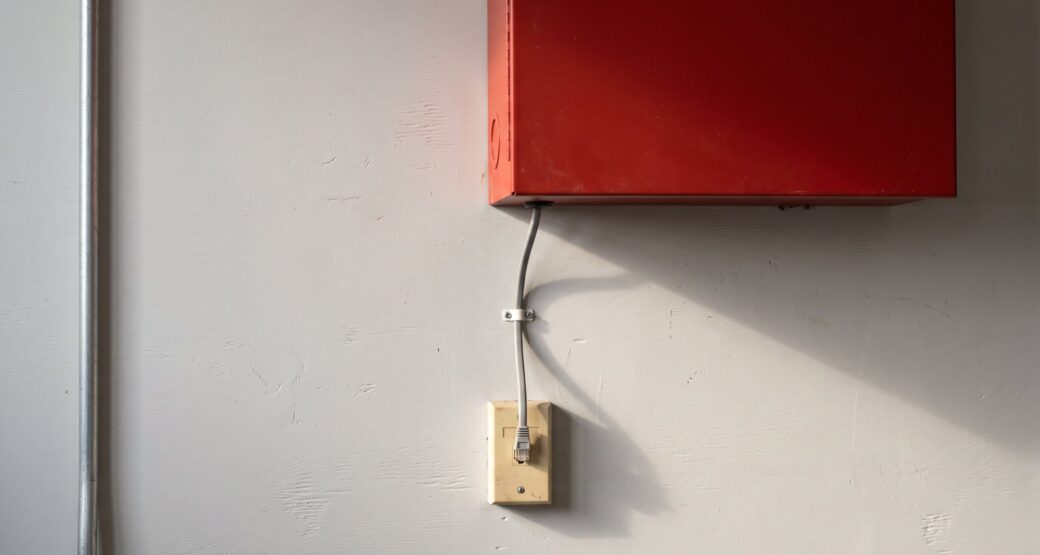
A monitored fire alarm has a communicator, the part that sends its signals to the monitoring center. It may be a separate box or built into the panel. A communicator built for a copper phone line needs that line.
If the phone company retires the line, or your building changes phone service without a plan for the fire alarm, the communicator may have no way to reach the monitoring center. The alarm can still sound inside the building. The call for help may not go out.
How do I know whether it affects me?
Start at the fire alarm panel and look at the cords and cables that leave it, and for any antenna nearby. You can check from the outside; there’s no need to open the panel. The diagram below shows the three connections you’re most likely to find.
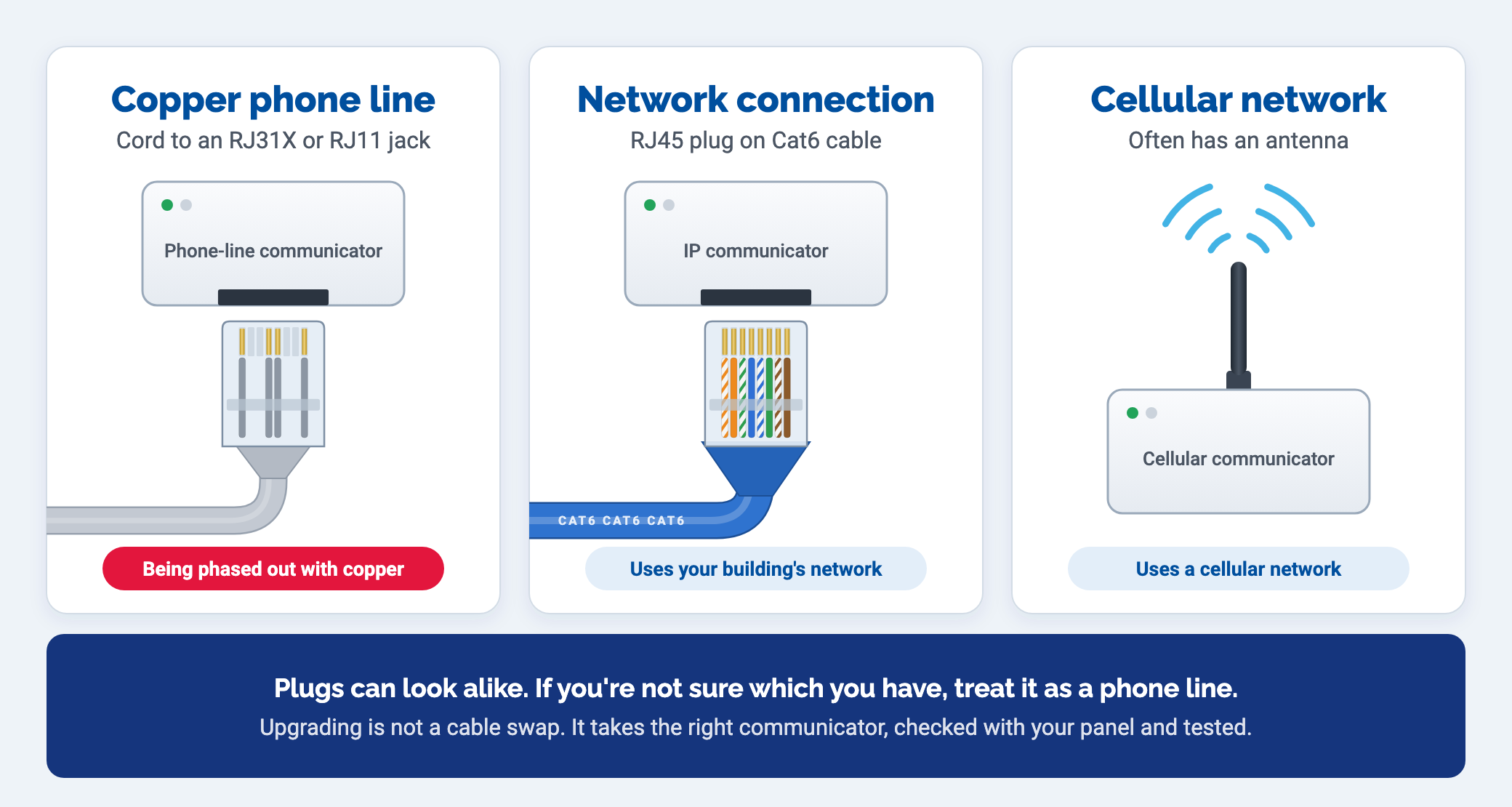
One caution before you compare: a phone cord and a network cable can end in plugs that look almost the same, and so can the jacks on the wall. If you’re not sure which one runs from your panel, treat it as a phone line until you know.
- Copper phone line. A phone cord runs from the panel to a phone jack on the wall. Installers call these RJ11 or RJ31X jacks.
- Network connection. A network cable, such as Cat6, with an RJ45 plug runs from an IP (network) communicator to your building’s network.
- Cellular. A cellular communicator sends signals over a cellular network. It often has an antenna, on the communicator or mounted nearby.
Some systems use two of these, such as a phone line with a cellular backup. If either one is a phone line, it’s worth a call.
Two more clues are worth checking. If your phone bill lists lines nobody seems to use, ask us whether one is a fire alarm phone line. And if the panel shows a trouble signal after any change to your phone service, call your fire alarm company right away.
If you can’t tell what you have, that’s what our free initial phone consultation is for.
What should I do about it?
- Call before you change anything. Talk to your fire alarm company before you change your building’s phone service: a new carrier, a new phone system, or cancelling a line that seems unused.
- Plan the new connection. Moving a fire alarm off copper is not a cable swap. It takes a communicator built for the new connection, checked for compatibility with your panel.
- Test it. Once the new connection is in, have it tested to confirm its signals reach the monitoring center.
- Check your state’s rules. Ohio and Florida each have one that applies.
- In Ohio, changing how a tested and accepted system signals the monitoring center takes written permission from the authority having jurisdiction, the official who enforces the fire code for your building (Ohio Fire Code 907.7.4, in effect since November 20, 2025).
- In Florida, an interruption of monitoring is to be reported to the authority having jurisdiction immediately, and in writing or electronically within five business days (Florida Administrative Code 69A-48.005, as amended October 14, 2021). The rule doesn’t say who reports it, so settle that with your fire alarm company first.
- Anywhere else, ask your fire alarm company what your state and local rules require before the change.
If your phone company is moving your building to fiber, there’s more to plan for. Ask us about it when you call.
Why should I call ProTech?
ProTech has protected businesses since 1981. Our teams in North Canton, Ohio, and Orlando, Florida, install, inspect, and service commercial fire alarm systems, and we offer monitored fire alarm systems.
Your first phone consultation is free. Tell us what you see at the panel and what’s changing with your phone service, and we’ll help you work out what it means for your fire alarm. If your system needs a visit, onsite diagnostics and service calls are billed at our normal service pricing.
Changing your building’s phone service? Contact ProTech to evaluate your fire alarm monitoring connection before making the switch. You can also call our North Canton office at (330) 499-3555 or our Orlando office at (407) 985-5069, or read more about our monitored fire alarm systems.
Related reading: When It Happened to Us, our account of the January 2026 fire that destroyed a building housing our own operations, and how our monitored alarm set the response in motion.
Frequently Asked Questions
Are copper phone lines being shut off on October 15, 2026?
No. October 15, 2026, is when the FCC’s revised rules for retiring copper lines and discontinuing phone service took effect. The rules streamline how phone companies retire copper lines. They don’t set a shutoff date.
How do I know if I have a fire alarm phone line?
Look for a phone cord that runs from the fire alarm panel to a jack on the wall. If you can’t tell what you’re looking at, treat it as a phone line and call your fire alarm company.
This post is general information and not legal advice. Rules change, and the authority having jurisdiction decides how they apply to your building.


