
A Three-Tier Framework for Keeping Your Security Systems Reliable Year-Round
Your commercial security system works around the clock, but that doesn’t mean it’s always working correctly. Cameras slowly lose alignment. Access credentials accumulate for employees who left months ago. Backup batteries drain quietly until the power goes out and the system doesn’t respond. These aren’t dramatic failures. They’re gradual degradations that go unnoticed until the moment you actually need your system to perform.
A structured commercial security maintenance plan prevents these invisible failures before they become costly incidents. The best plans don’t treat maintenance as a single annual event. Instead, they operate across three distinct tiers, each serving a different purpose in keeping your security infrastructure reliable. Let’s take a deeper look.
Ready to get more proactive with your commercial security maintenance? Contact ProTech Security today to discuss a free on-site assessment of your facility’s security needs.
The Three-Tier Commercial Security Maintenance Framework
Tier One: Ongoing Automated Monitoring
The foundation of any effective maintenance plan is continuous system oversight. This means the ability to detect issues in real time rather than discovering them during a scheduled visit or, worse, after an incident.
Automated monitoring tools analyze your security infrastructure around the clock, tracking camera connectivity, recording integrity, access control system responsiveness, and network performance. When something falls outside normal parameters — a camera drops offline, a hard drive approaches capacity, a sensor stops reporting — the system flags it immediately rather than letting it quietly fail.
ProTech’s Health Check service operates at this tier, providing continuous oversight of your surveillance infrastructure between scheduled maintenance visits. Rather than relying on staff to notice when a camera stops recording or a feed degrades, Health Check catches these issues proactively and alerts your service team before they become security gaps.
For commercial facilities running 24/7 operations, automated monitoring is the difference between a minor service call and a discovered vulnerability.
Tier Two: Periodic Inspections
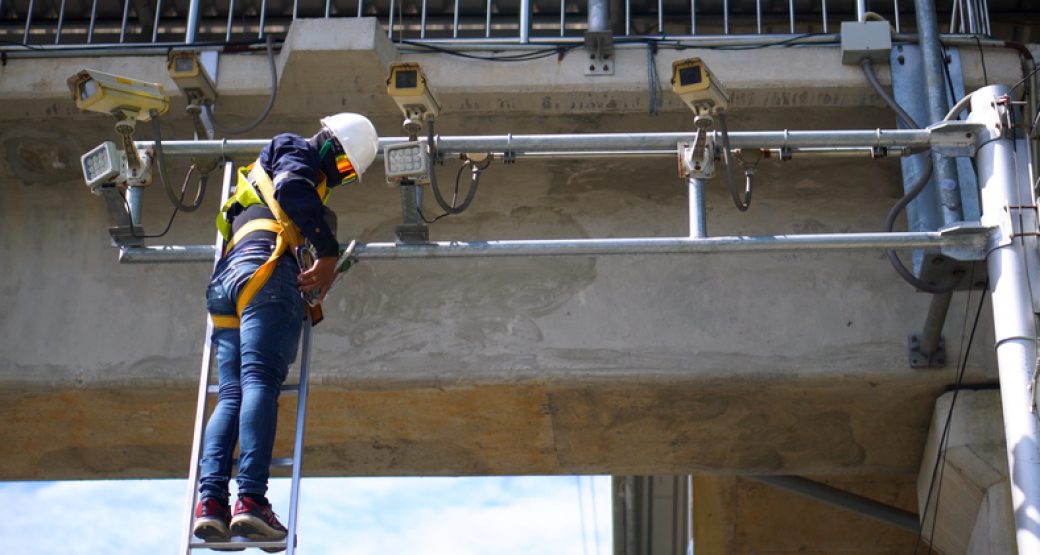
Automated monitoring catches performance anomalies, but it can’t physically inspect camera housings for damage, test manual pull stations, or verify that access control readers are properly aligned and responding. That’s the role of periodic inspections conducted by trained technicians on a scheduled cadence.
Effective periodic inspections cover all system types, not just cameras. A complete inspection cycle should include:
Video surveillance — physical inspection of camera housings, mounts, and lenses; verification of recording schedules and storage capacity; confirmation that camera angles still cover intended areas following any facility changes.
Access control — audit of active credentials to remove departed employees and contractors; testing of card readers, fobs, and keypads; verification that door hardware and locking mechanisms are functioning correctly.
Intrusion detection — testing of motion sensors, door and window contacts, and glass break detectors; verification of alarm panel communication with monitoring centers; battery backup testing across all devices.
Fire detection — functional testing of smoke and heat detectors, manual pull stations, and notification devices; verification of panel communication and emergency dispatch connectivity.
According to NFPA 72, fire alarm system components require testing at defined intervals to maintain code compliance — meaning periodic inspections are a regulatory requirement for most commercial facilities. The same principle applies across your broader security infrastructure: regular documented testing is your evidence of due diligence if an incident ever leads to an insurance claim or liability review.
Tier Three: Annual Professional Review
The third tier goes beyond inspecting individual components to evaluating your security infrastructure as a whole. An annual professional review asks a broader set of questions: Is your current system still matched to your facility’s security needs? Have building modifications, occupancy changes, or operational shifts created new vulnerabilities? Are your systems integrated effectively, or have they drifted out of alignment?
Annual reviews conducted by an experienced security integrator also address technology lifecycle considerations. This includes identifying components approaching end of life, flagging firmware or software that requires updating, and recommending upgrades where current equipment is limiting system performance.
This is also the right moment to review your monitoring service agreements, verify that emergency response protocols are current, and confirm that your security team understands how to operate every system component correctly. Documentation produced during the annual review becomes the foundation of your compliance record and the baseline for the following year’s maintenance planning.
Making the Plan Work: Partner With a Security Integrator
A three-tier maintenance plan is straightforward in principle, but requires consistent execution across multiple system types, coordinated scheduling, and the technical expertise to identify issues that aren’t obvious to untrained eyes. For most commercial facilities, that means partnering with a security integrator who can manage all three tiers rather than treating each as a separate vendor relationship.
ProTech Security provides inspection, repair, and ongoing service support for commercial facilities across Northeast Ohio and Central Florida — with locally staffed technicians who know your systems and your facility. From Health Check monitoring through periodic inspections and comprehensive annual reviews, we support the full maintenance lifecycle so your security infrastructure performs reliably when it matters most.
Contact our team today to build a commercial security maintenance plan tailored to your facility’s systems and schedule.


