
By ProTech Editorial Team
Your fire alarm inspection report lists a device that did not pass its test. The building is open, the panel looks normal, and a repair quote is coming. Does the system still work? Can the repair wait for the next budget meeting? Who needs to know?
The report may not answer those questions in one line. But they can be answered. Start by finding out what the problem affects today, then connect the inspection finding to a repair plan and a record of the result. The important decisions begin before the quote arrives.
First, find out what the system can and cannot do
A commercial fire alarm system has several jobs. It may detect a condition, warn people in the building, send a signal to a monitoring center, and activate other building functions. A problem in one part can affect one or more of those jobs. The technician needs to assess the actual system before anyone can say how much is affected.
Ask the person who performed the inspection to explain four things in plain language:
- What was found, and where? Ask for the device, function, and location, not just a reference number.
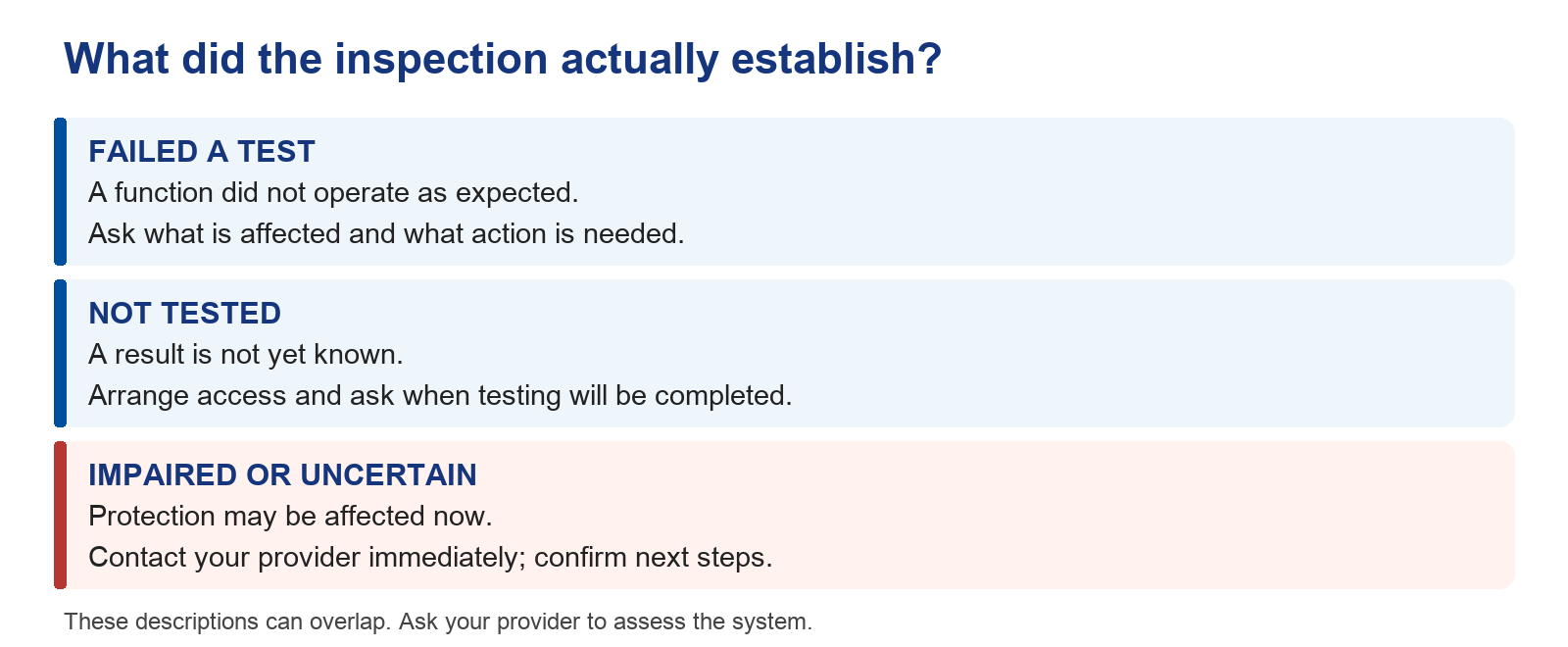
- What was the result? Did it fail a test, or was it inaccessible and therefore not tested? An untested device is an unanswered question, not a confirmed failure or a confirmed pass.
- What does the finding affect? Ask what the system can and cannot do in the affected area, whether the monitoring connection or another building function is involved, and whether the system or any part of it is impaired or out of service.
- What happens now? Ask what requires immediate action, who needs to be notified, and whether temporary measures are needed while the finding remains open.
If a function is impaired, out of service, or its status is uncertain, contact your fire alarm provider immediately. Do not wait for a quote to discuss the situation. Contact the local fire official promptly as appropriate, and establish who is handling any required notifications. The official may require temporary protective measures. Confirm what applies with the official and qualified provider rather than assuming a standard workaround will fit your building.
Why a normal-looking panel is not the whole answer
The fire alarm panel is the system's control unit. It receives information from connected devices and controls system responses. According to NFPA's fire alarm basics guide, it can display different conditions, including an alarm, a trouble condition, or a supervisory condition.
In everyday terms, a trouble signal points to a fault in the fire alarm system. A supervisory signal can indicate a condition in equipment or a process the system monitors, such as a closed sprinkler valve. These signals do not all mean the same thing, and the actual response depends on the condition and system. Ask your provider to explain an unfamiliar indication; don't reset or silence it as a substitute for resolving the underlying issue.
The reverse is also important: a normal display does not tell you that every device passed its physical test. Imagine a technician tests a hallway notification device, the horn or light intended to alert occupants, and finds that it did not operate as expected. The technician must determine the cause and extent. You cannot conclude from the display alone that the device works, or that the entire system has failed.
That is a hypothetical example, not a diagnosis. The useful question for the building manager is: “Which part of our warning or communication process is affected, and how do we protect the affected area until it is addressed?”
A repair quote is not the inspection report
The inspection report records what was checked and what was found. A quote describes proposed work. Put the two side by side before approving the work.
Suppose the report identifies one notification device that failed and another device that could not be reached because a room was locked. The quote may cover a diagnostic visit for the first item but say nothing about returning to test the second. Approving the quote alone would not answer both questions.
For each report item, ask the provider to identify:
- The proposed action. Is the next step diagnosis, repair, replacement, a return visit for testing, or something else? A failed test does not always establish the cause.
- The scope and price. Which findings does the proposal cover? What is excluded, and what might require a revised estimate after diagnosis?
- The timing and decision-maker. When can the work be done, and who has authority to approve it? If the site manager cannot authorize the cost, involve the owner or budget holder early.
- The interim plan. If a part is delayed or a visit must be rescheduled, who will reassess the affected protection, notifications, and any temporary measures with the appropriate parties?
An inspection agreement, repair agreement, and monitoring service can have different scopes. Check the signed terms rather than assuming an inspection fee includes the repair or that a monitoring service covers every follow-up visit.
Who needs to know, and when?
The answer depends on the finding, the building, and the rules that apply locally. The people involved may include the owner or designated representative, the inspection and repair companies, the monitoring provider, building management, and the local fire official, also called the authority having jurisdiction.
Do not let “someone will call” be the plan. Ask who is making each required notification, when it will happen, and how the responsible person will receive confirmation. If the provider submits a notice, request a copy or confirmation. If responsibility is unclear, resolve it promptly with the provider and fire official.
The same applies when repairs require a planned interruption. Ask the provider what will be taken out of service, who must be notified before work begins, and who will confirm that the affected functions have been restored afterward. Requirements and time frames can differ; a quote's expiration date is not a fire official's repair deadline. If the proposed schedule cannot meet a direction or deadline, raise that immediately.
What does “fixed” look like?
A completed invoice tells you that work was billed. It may not tell you which original finding was resolved, what was tested afterward, or whether another item remains open.
Before closing the file, ask the provider for a record that connects the work back to the report: the location and finding, the action taken, and the result of the appropriate checks. If a device could not be tested during the inspection, obtain the result of the return test. Confirm whether the fire official requires an updated report, a follow-up inspection, or notice that an impaired system has been restored.
Keep a short open-items list with the original report and service records. For each item, note the affected location and function, current status, responsible person, next action and date, and the document showing the result. Update it if the schedule or system status changes. That record is especially useful when the person who received the inspection report is not the person who later approves the work.
Start with the finding, not the paperwork
An inspection is most useful when its findings lead to decisions. You should be able to explain what is affected, who is responsible for the next action, and how the result will be checked. If any of those answers is missing, ask for a walkthrough before the report disappears into a file.
ProTech's inspection team can review its findings with you and discuss appropriate next steps for your system.


