
From the Installation and Service Team at ProTech Security. Current as of November 17, 2026.
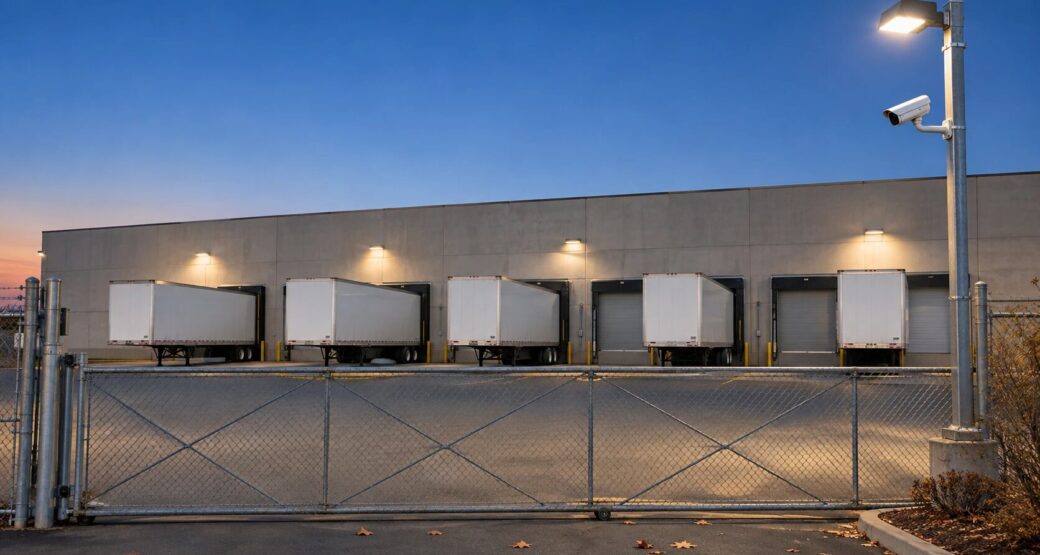
Thanksgiving is Thursday, November 26. For a lot of warehouses, distribution centers, and yards, that means a rushed short week, a thin crew, and freight that sits for four days.
That’s the kind of gap thieves look for. In its third-quarter theft report, published November 4, Verisk CargoNet warned that activity “could escalate” as criminals exploit extended facility closures and reduced staffing during the holiday season.
Here’s where the risk sits during Thanksgiving week, how to tell whether your site is exposed, and what to do before your last shift leaves.
What risk do I have?
CargoNet recorded 547 supply chain theft incidents in the third quarter of 2026, down 33 percent from a year earlier. Losses are rising anyway: $718.9 million through September, up 39 percent.
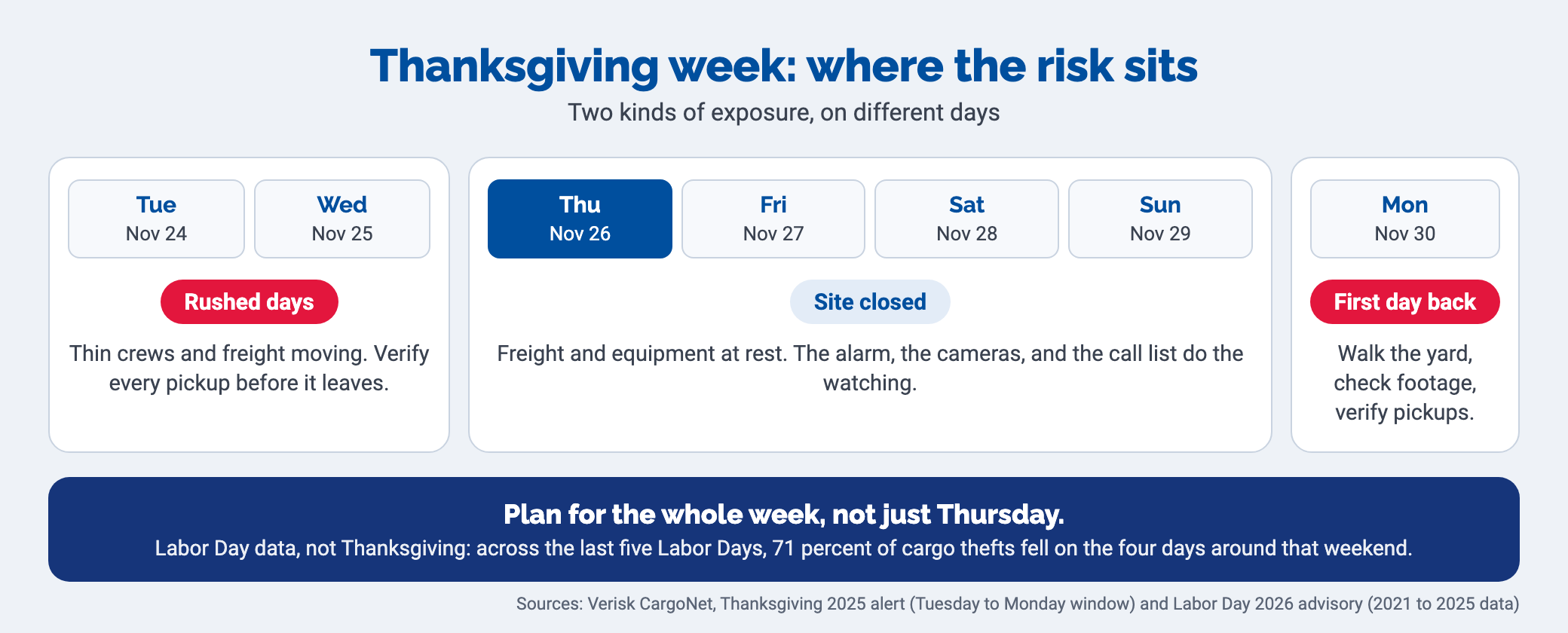
Thanksgiving week has its own track record. CargoNet’s holiday alert looks at the Tuesday before Thanksgiving through the Monday after. In 2024, that window recorded 79 theft incidents, up from 48 the year before. In its five-year Thanksgiving review, warehouses and distribution centers were the most common location, followed by parking lots.
The empty long weekend isn’t the only risk. CargoNet’s latest Thanksgiving alert doesn’t break the week down by day, but its Labor Day analysis does. Across the last five Labor Days, the four days around the holiday weekend accounted for 71 percent of incidents, while the weekend itself was comparatively quiet. That’s a Labor Day figure, not a Thanksgiving one. We use it here as a planning guide for any holiday closure. CargoNet’s Labor Day analysis describes two risks that overlap:
- Freight at rest. Loaded trailers, staged orders, and stock sit untouched while the site is closed.
- Rushed days on either side. Busy, short-staffed days make it easier for someone to show up with convincing paperwork for a load that isn’t theirs. CargoNet counted 138 of these fictitious pickups across the third quarter of 2026, about a quarter of all reported incidents.
Metals were the second most stolen type of cargo in the third quarter, with 63 incidents, 34 of them copper. Food and beverage shipments topped the list.
One more detail is worth knowing before you close. CargoNet warns that thieves targeting warehouses tend to trip a facility’s alarm several times before a break-in, so the people who respond start to believe the system is broken. A run of “false alarms” the week before a holiday is a reason to look closer, not to ignore the next one.
In Florida, the state is one of the five with the most Thanksgiving-period thefts in CargoNet’s five-year review.
How do I know whether it affects me?
Answer these five questions about your site:
- What stays behind? Loaded trailers, staged orders, finished inventory, copper or other metal stock, and equipment all count.
- Who’s on site, and when? Count the days around the holiday, not just Thursday. A skeleton crew releasing loads on Wednesday is part of the exposure.
- Does anyone see the cameras while you’re closed? Cameras that only record tell you what happened after the fact. Someone has to see an alert before anyone can respond.
- What happens when the alarm goes off at 2 a.m. on Friday? Does the monitoring center have current numbers for people who will answer? And has the alarm been going off lately for no clear reason?
- Who still has a way in? Former employees, contractors, and vendors with active cards, fobs, codes, or keys are an open door.
If you aren’t sure about the third, fourth, or fifth answer, that’s where to start.
What should I do about it?
Work through this list before your last shift leaves.
- Walk the site. CargoNet’s warehouse security tips start with checking that lighting, backup generators, alarm systems, surveillance equipment, perimeter fencing, and other barriers are all in working order. CargoNet also recommends asking local police to make routine checks during holiday downtime.
- Test the alarm and update the call list. Have your alarm company or monitoring center confirm signals go through, including any backup connection, and that the system is back in normal service after the test. Put people on the call list who will be reachable and can get to the site, and take off anyone who won’t. Agree that nobody walks into the building alone when the alarm goes off; the monitoring center or 911 brings in police, and responders wait for them. If your alarm still calls out over a phone line, our post on copper phone lines explains why that connection is worth a look.
- Check every camera, then record the site. Make sure each camera is recording, the lights keep the view clear at night, and someone can pull up footage without driving in. Then take a quick video walkthrough and inventory of freight and equipment as you leave, so it’s easy to show what changed, and when.
- Secure freight and equipment. Ship or unload staged freight before the closure where you can. For trailers that have to stay, CargoNet recommends kingpin locks and high-security barrier seals. Pull the keys from forklifts, pallet jacks, and other equipment.
- Close the access gaps. Turn off cards and codes for people who no longer need them, and set the access control system to holiday hours.
- Verify every pickup. CargoNet advises confirming pickups and appointment changes through contacts you already trust, such as a call back to a number on file, not the number on the paperwork in front of you. Cameras and alarms won’t stop a convincing fake pickup, so this step is a process fix.
- Plan the first morning back. Walk the yard, check the footage, and verify pickups before freight leaves. The days after the holiday carry risk too.
In Ohio, late November nights can drop below freezing. If the heat goes down while you’re closed, keep enough heat on to protect water-filled sprinkler piping and water lines. FM Global, a commercial property insurer, also recommends that sites not reduce their level of supervision when they sit idle.
Thanksgiving won’t be the last closure this year. CargoNet’s review of the December 23 to January 2 holiday period counted 353 incidents across five years, so the same list is worth running again in December. If you run a construction site, our post on winter downtime security covers jobsite steps.
Why should I call ProTech?
Our teams in North Canton, Ohio, and Orlando, Florida, install and service commercial alarm, video, and access control systems. A few of the options that fit a site that sits closed:
- Virtual Guard pairs cameras with a speaker and strobe. When someone crosses a virtual fence, the central monitoring station can speak to them and dispatch authorities.
- Video verification sends video clips of an intrusion to the central monitoring station so the alarm can be confirmed before police are dispatched.
- Access control lets you schedule who can get in, and when, and records each time a card, fob, or code is used.
If there isn’t time to add anything before Thanksgiving, call us anyway. We can help you check what you have, work out who responds, and plan ahead for the December closures.
Your first phone consultation is free. If your system needs a visit, onsite diagnostics and service calls are billed at our normal service pricing.
Talk to Us About Your Holiday Closure
The form starts your request with Video Surveillance selected and a message you can add to. You can also call our North Canton office at (330) 499-3555 or our Orlando office at (407) 985-5069.
Frequently Asked Questions
Is Thanksgiving weekend the riskiest time?
Not on its own. CargoNet’s Thanksgiving analysis runs from the Tuesday before the holiday through the Monday after, and its latest alert doesn’t split that week by day. Its Labor Day data is the closest guide: across the last five Labor Days, most thefts fell on the days around the holiday weekend, when freight was moving and crews were thin. Treat that as a planning guide, not a Thanksgiving forecast, and plan for the whole week.
Do security cameras stop theft on their own?
No. Cameras that only record give you footage to review later. Monitored video and video verification add a person who sees the alert and can act on it. That helps deter theft and supports the response.
Should someone go check the building when the alarm goes off?
Not alone. Let the monitoring center or 911 bring in police, and have whoever responds wait for them before going in. Then review the footage together and decide what needs to happen next.


